Grid Pre-Conditioning Menu
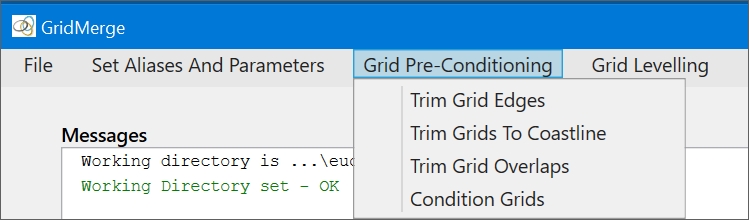
Launches the processes for pre-conditioning grids prior to levelling. In all cases, grids are read from the input directory, modified, then written to the output directory. The grid names remain the same. The output directory will be created, if necessary. If the output directory exists, its contents are deleted at the start of processing. None of the grid pre-conditioning processes are essential, but they do facilitate a better final product.
- Trim Grid Edges replaces the edges of grids (or grid margin) with nulls. Gridding algorithms sometimes extrapolate beyond the edge of data, leaving edge cells not well constrained. Also, decorrugation (microlevelling) can leave the edges of grids corrupted (either too high or too low). Trim Grid Edges can be used to remove these affected cells. If not all the grid edges are affected, then the Sub-Section a Grid tool can be used to trim the affected edges instead.
- Trim Grids To Coastline replaces offshore parts of grids with nulls. This process is only used on radiometric grids where there is no useful information offshore.
- Trim Grid Overlaps trims grids such that they only overlap along their margins. The best levelling results are obtained when only the differences along the grid edges are used to do the levelling. However, too little overlap can be just as bad as too much. There must also be a reasonable overlap for effective feathering – perhaps 4000m for 100m cell size. Trimming overlaps runs a lot faster if grids can be cached to memory – memory cache can be set on the Set Aliases And Parameters window.
- Condition Grids condition grids for processing by either centring the grid (transform to mean=0), or centring and scaling (transform to mean=0 and standard deviation=1). Conditioning is not really necessary for levelling a small number of grids. However, for large merges (many tens or hundreds of grids), conditioning will minimise the probability of rounding errors corrupting the results.