Decorrugation and Microlevelling Fundamentals
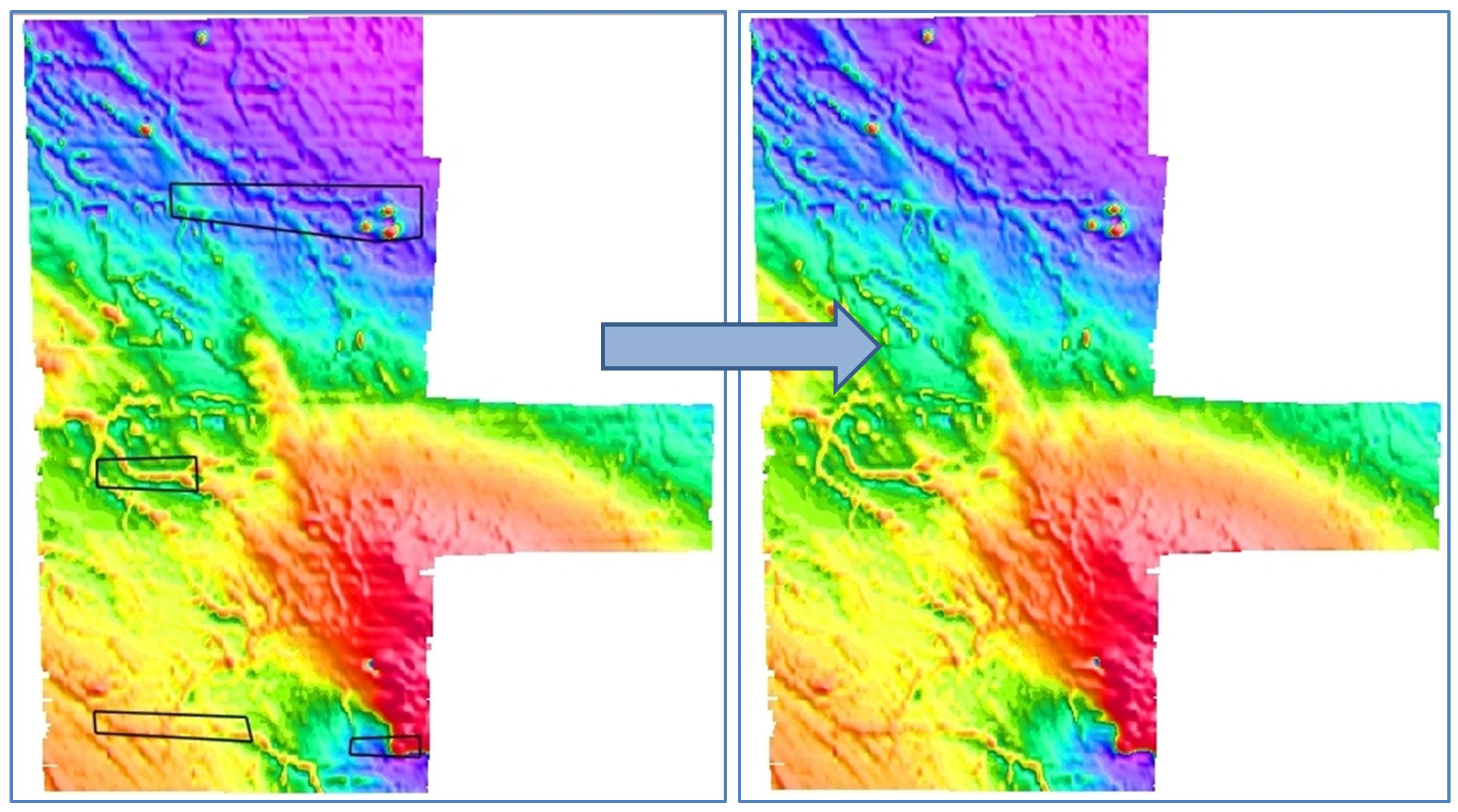
Residual levelling errors in airborne magnetic and radiometric data, after tie-line levelling, are usually characterised by long wavelengths in the line direction (typically greater than the tie-line spacing), and short wavelengths in the direction perpendicular to the flight lines with a wavelength precisely twice the line spacing. This distinct spectral signature suggests that directional filtering may be a good solution to this problem. Minty (1991) proposed a simple method that applies low and high-pass filtering to the rows and columns of the grid in sequence. This requires that either the rows or columns are in the flight line direction. Where this is not the case, grids may first have to be rotated into the line direction. The strategy is best described by considering the schematic diagram below, based on an E-W line direction.
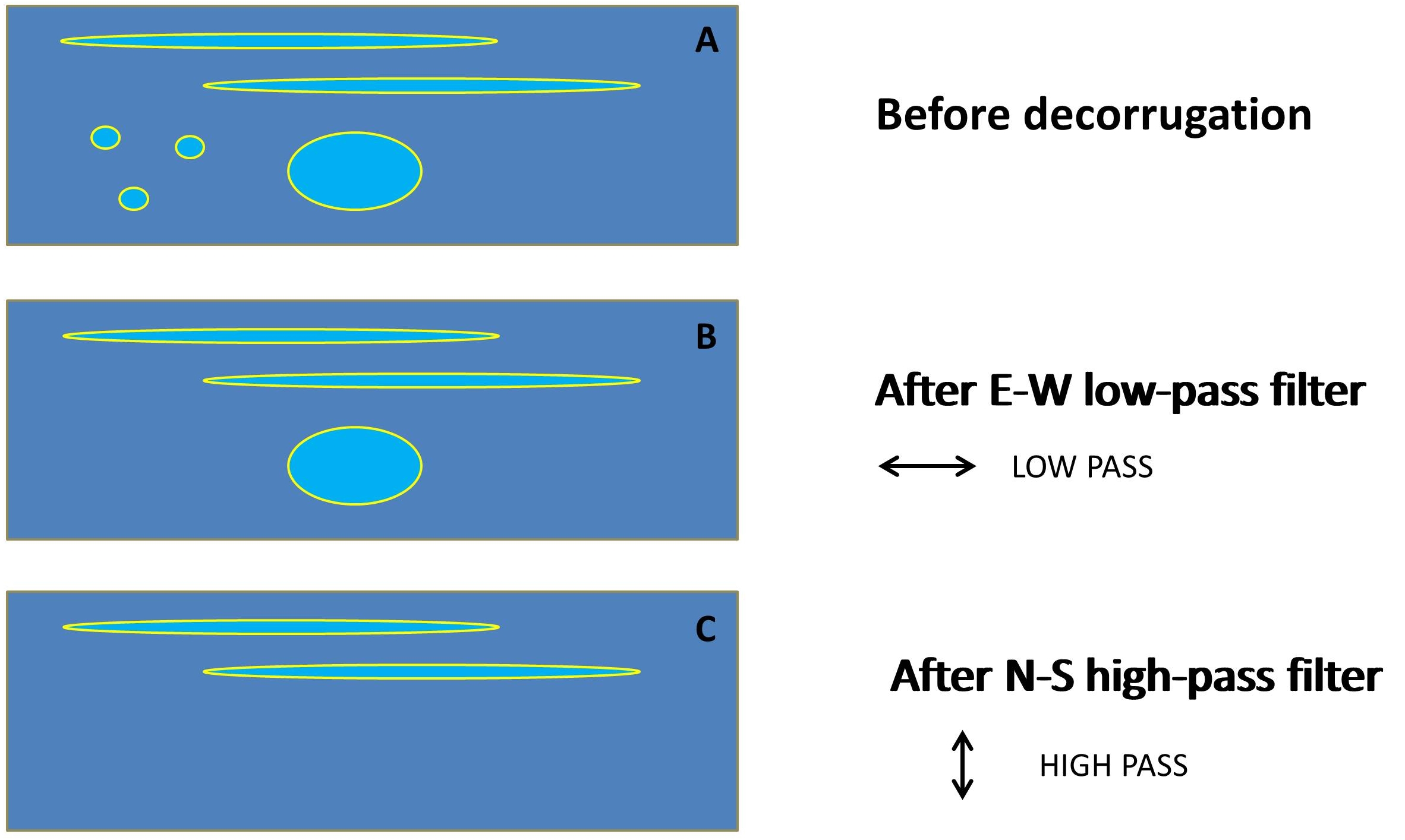
Grid A contains 3 types of anomalies:
- Anomalies elongate in the E-W line direction. These are the anomalies we wish to remove.
- Short-wavelength anomalies - short wavelength in both E-W (rows) and N-S (columns) directions. We wish to keep these anomalies.
- Broad anomalies with long wavelengths along both rows and columns. We wish to keep these too.
The elongate E-W anomalies are removed by first low-pass filtering the rows of grid A to get grid B, then high-pass filtering the columns of grid B to get grid C. Grid C is the correction grid, which is then subtracted from Grid A. A similar strategy applies to surveys with lines flown in the N-S direction.
There are three significant problems with the application of the method:
(a) Low pass 1D filter "leakage", where large, high-frequency anomalies (or sharp edges) produce a streaking into the filtered grid on either side of the anomaly. While an ideal low-pass filter has a sharp cutoff, real-world filters have "transition bands." High-frequency signals near the cutoff frequency "leak" through the filter. Examples are shown in the image below. The rows of the image have been filtered using a low-pass Fuller filter (Fuller, 1967), and the yellow arrows point to the artefacts.
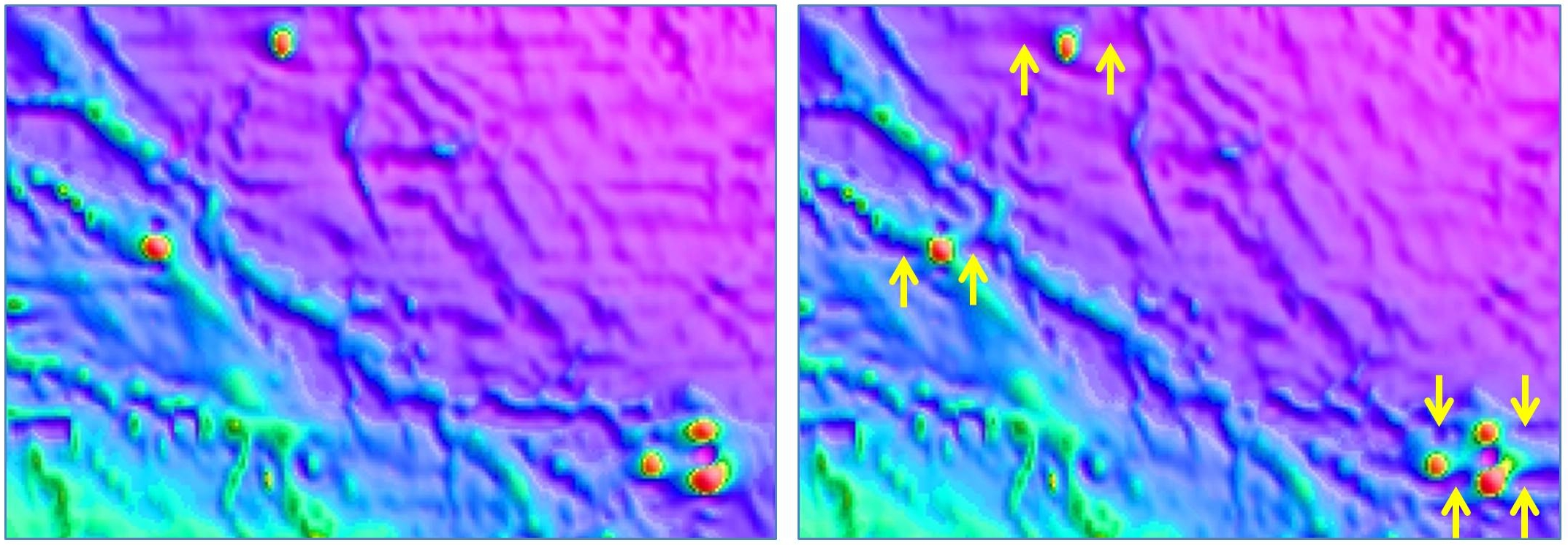
In this example, the anomalies are all positive. But the same applies to negative anomalies and sharp edges. MicroLevel ameliorates this problem by using two filters to effect the low-pass filtering: First, the rows (or columns for NS line directions) are filtered using a median filter to try and remove the high-amplitude, short-wavelength anomalies. So the median filter should be at least twice as wide as these features. This is followed by a Savitzky-Golay (degree 2 polynomial) low-pass filter with a cut-off wavelength that targets the shortest long-wavelength artefacts. The width of the median filter is typically half that of the Savitzky-Golay filter.
(b) The second problem is that there may be real elongate anomalies in the line direction, and the decorrugation will remove these as well! MicroLevel provides a solution to this problem by way of excluding some parts of the grid from being levelled using polygons. Polygons can be created using MicoLevel's Create Polygon tool. Any number of these can be loaded before decorrugation, and the areas inside these polygons will not be decorrugated. The polygons can also be used to exclude areas where the median/Savitzky filter combination has still resulted in filter leakage.
(c) Where a grid has irregular boundaries and significant anomalies on the edges of the grid, the filtering can introduce edge effects - streaks in both the NS and EW directions emanating from the edges. The solution here is to pad (or "plug") all the null values with interpolated values prior to the decorrugation. After decorrugation, the nulls can be re-inserted into the output grids (decorrugated and correction grids).
References
Fuller, B, D. (1967). "Two-dimensional frequency analysis and design of grid operators", in Mining Geophysics, v2, Society of Exploration Geophysicists, p658-708.
Minty, B.R.S. 1991. Simple micro-levelling for aeromagnetic data. Exploration Geophysics, 22, 591-592.